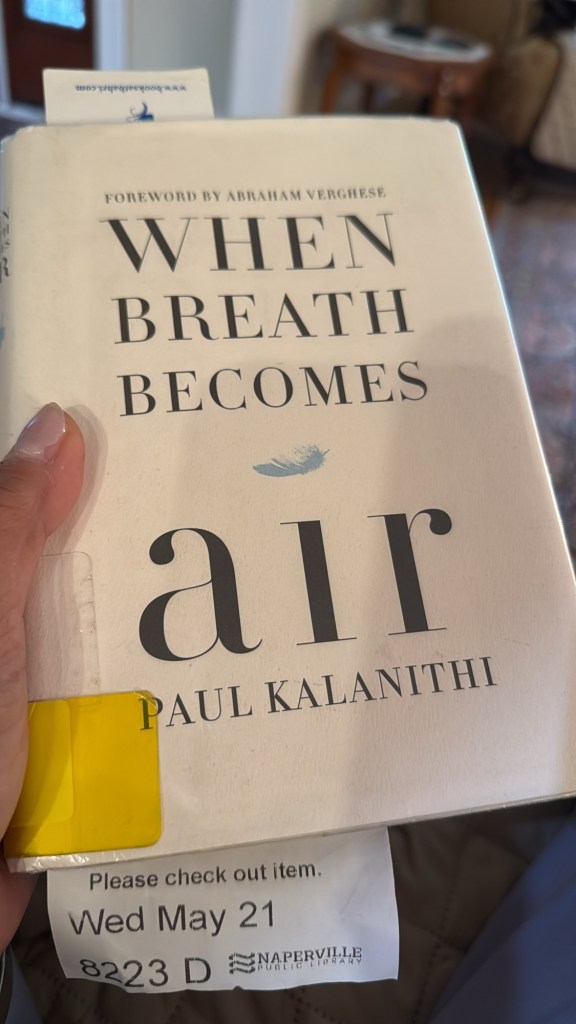
So much has been written about this book since its publication 10 years ago. My two cents…
Reading ‘When Breath Becomes Air’ was a deeply emotional and difficult experience for me. Paul Kalanithi’s reflections on mortality and meaning hit especially close to home because I myself narrowly escaped death in July 2024 after suffering a heart attack. His words felt painfully intimate—both as a reminder of life’s fragility and as a meditation on how to live with purpose when time feels suddenly finite. This book didn’t just move me; it held up a mirror to my own journey, making it one of the most powerful, albeit challenging, reads of my life.
Some books don’t just speak to you—they sit with you in silence, in pain, in reflection. When Breath Becomes Air by Paul Kalanithi was one of those books for me.
I read it in the aftermath of something I’m still processing: a heart attack I had in July 2024. I came terrifyingly close to not making it. Since then, life has felt more fragile, more vivid, and sometimes more confusing than ever. So reading Paul’s story—a brilliant neurosurgeon forced to face his own mortality after a terminal cancer diagnosis—wasn’t just emotional. It was personal.
There’s a line that hit me like a punch to the chest:
“Even if I’m dying, until I actually die, I am still living.”
After my own experience, I know how real that is. You don’t just “recover” from a brush with death—you carry it with you. And Paul captured that strange, in-between state with such honesty and grace.
What moved me most wasn’t just the fact that he was dying—it was how he chose to live in spite of it. His writing is full of clarity, warmth, even humor. He writes:
“The fact of death is unsettling. Yet there is no other way to live.”
It made me stop and think—about how often we pretend we have all the time in the world, when really, none of us do. Paul’s words made me realize that facing death doesn’t strip life of meaning—it sharpens it.
I imagine he must’ve felt heartbreak, urgency, and fierce love all at once—especially when he became a father near the end of his life. You feel all of that in his writing. And if you’ve ever had your world shift in a single moment, like I did last year, this book won’t just speak to you—it’ll meet you where you are.
I have to point out here that some parts of his writing were beyond my comprehension. The parts where he opines about various philosophies of life. He quotes and discusses Nietsche, Darwin, Seneca, Eliot and Beckett. A student of English Literaturr myself, I’ve read them before but his depth of interpretations are far beyond what my superficial inelegance can fathom.
Finally, it is safe to say that ‘When Breath Becomes Air’ wasn’t an easy read by any measure.. But it was the right one. I’m grateful I found it—or maybe, that it found me.
 lopastuff.com